Microschool Starter Training
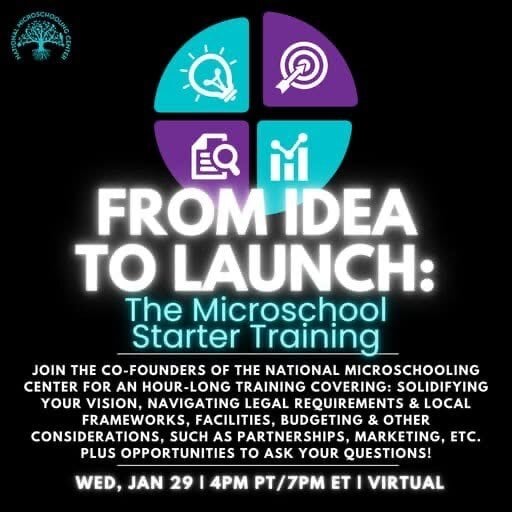
Calling all prelaunch microschool founders! Do you have a microschool idea that you're ready to bring to life? The Center is here to support you!
2 min read
Ashley Soifer
:
Dec 18, 2025 1:42:43 AM
(Read through to the bottom for an announcement from the Center).
Microschool founders are, by nature, builders. They are creators, designers and relationship cultivators. They design learning environments from the ground up. They reimagine relationships between students and adults. They hold community, culture, and curriculum in careful balance. And a great many do it well.
For microschool founders who come to this movement from a previous educational setting (35 percent are currently licensed teachers or administrators, 19 percent are formerly licensed, and 32 percent have experience as professional educators who have not held public teaching licenses), many quickly discover, however, is that while they were well prepared to teach children in innovative, relationship-based ways, they might not be prepared to operate a business.
Traditional education systems do not train educators to run small, independent, community-rooted schools. When founders leave those systems and build new and beautiful learning environments, they often step into a landscape filled with responsibility, complexity, and decisions they have never had the opportunity to navigate before in their roles as an educator.
For educators transitioning out of traditional schools, pertinent professional development becomes harder to access. For microschool founders that want to keep their teaching or admin license, this can be a barrier.
PD hours that once came automatically through districts or charter schools and networks are suddenly difficult to find. Founders and staff are left navigating fragmented offerings that were never designed for small, autonomous learning environments. And the offerings that are available are more often than not something that checks the box vs. something that actually adds value to the work being done by the microschool leader.
The result is a paradox: educators are doing some of the most innovative work in education, yet are cut off from meaningful, relevant professional learning that counts as professional development hours.
Microschool leaders and educators deserve professional learning that is as intentional as the schools themselves.
That means training that:
Across the country, founders consistently ask for training that is practical, credible, and rooted in real microschool experience. They want guidance that respects their vision while strengthening their capacity to lead sustainable, high-quality schools.
Over the past several years, the National Microschooling Center has worked alongside founders, researchers and policymakers to understand where gaps exist and how they can be responsibly filled. Through research, technical assistance, convenings, and field-driven tools, one theme has emerged clearly: the need for coordinated, microschool-specific professional learning.
Not one-off workshops. Not generic education PD. But a coherent ecosystem of training that reflects how microschools actually operate.
Quietly, intentionally, that infrastructure is taking shape. And it’s right here at the Center.
The next chapter of microschooling will be defined not only by innovation in classrooms, but by the strength of the support systems behind them.
We are excited to announce that the National Microschooling Center will be launching the National Microschooling Center Training Institute in 2026. This institute will house asynchronous trainings, live office hours, cohorts, certificates for professional development hours (in select states) and so much more.
This is just the beginning. We can’t wait to show you what’s next.
Calling all prelaunch microschool founders! Do you have a microschool idea that you're ready to bring to life? The Center is here to support you!
What is a microschool? The National Microschooling Center get asked this question a lot, almost every day. And we are thrilled to share this series...
In recent years, microschools have gained traction as a viable alternative to the traditional K-12 educational model. These small, often personalized...