Measuring What Matters: Results from the Center’s Working Group
 Ashley Soifer : Aug 2, 2025, 4:38:48 PM
5 min read
I've spent the last 15 years building learning environments that recognize learning is natural and happening all the time. I co-founded the Agile Learning Centers network, helped launch the Alliance for Self-Directed Education, and since 2014 I've led operations at ALC Mosaic, a 90-student microschool in Charlotte, North Carolina. I've watched kids build businesses, teach themselves to code, spend months obsessed with marine biology or chess or historical warfare, and grow into thoughtful, capable people without standardized test scores to prove any of it.
I know this works. The people in this space know it works. We see it every day.
But for over a decade, I struggled with something I think most microschool founders struggle with: how do you capture and communicate the depth of learning happening in environments where learning doesn't follow a single script?
Every microschool I've been part of has wrestled with this. We all take pictures. Most of us have some version of the story where educators snap hundreds of photos throughout the week, post a few to a Slack channel or shared album, and then most of it just sits there. Every couple of months, staff spend a painful weekend pulling fragments together for a yearbook, a parent report, or to construct a narrative from memories.
We tried everything. ClassDojo, Seesaw, shared drives, blogs, wikis. None of them understood our experience. They were built for classrooms with one teacher, one age group, one curriculum. In a microschool, five kids of different ages might be deep in a project together, and you want that moment to land in each of their portfolios in one step. A parent might want to document valuable experiences or growth that happened at home, on a home day, or over the weekend. A tutor who comes in twice a week might want to add their observations. The tools we had couldn't do any of that without a painful workaround.
And then there was the portability problem. We'd spend years building rich documentation for a child, and when that family moved on, all of it stayed locked in whatever platform we were using. The learning belonged to the child, but the record of it belonged to the institution. That felt wrong.
These aren't abstract problems. They're the daily friction that makes documentation feel like a chore instead of a practice, and they're why most educators in this space eventually stop doing it consistently. Not because they don't care, but because the tools make it too hard.
Last year, I realized I had enough technical literacy, and the tools available had advanced far enough that I could build what I'd been wishing existed for a decade. So I did.
Prism is a learning documentation and portfolio platform built specifically for microschools, homeschoolers, and hybrid learning communities. The basics are exactly what you'd want: an educator can take a photo of five kids working together, tag all of them, write a quick note about what's happening, and have it land in each child's portfolio in one step. Parents, educators, and tutors can all contribute to the same learner's record. Parents can share ownership with a spouse or co-parent, or give view-only access to a grandparent or family member. The portfolio belongs to the family, so when they move on, their child's learning history goes with them.
That's the practical layer. The conceptual layer is something we call Learning Signals: when an educator or parent captures a moment, Prism surfaces the educational dimensions present in the experience; subject areas, skills, developmental domains, interests. Not replacing the observer's description, but expanding it. Making the structure visible without forcing the experience into a predetermined box.
That part has turned out to matter more than I expected. But the people using it can describe it better than I can.
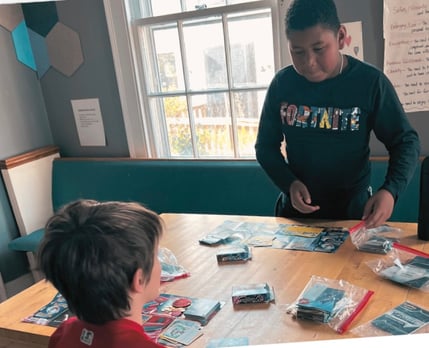
Lauren Umlauf runs The Dandelion Project, where four to five facilitators document daily. "Any offering that is facilitated, we document in Prism," she told me. "We also try to regularly catch kids engaged in activities that are meaningful to them that aren't facilitated; the group at the LEGO table, people gathered to play Spit on the outside trip, small group discussions."
Their team runs an annual Comedy Club where students write, film, and edit a sketch comedy. This year, Lauren documented the parts that usually go uncaptured: how the kids designed a casting process, the moment the group decided to take a big left turn on the script, the small negotiations and accommodations that made the whole thing work.
"There are so many soft skills," she said. "Collaboration, listening, communication, considering equity and empathy in design. I recorded them this year that I haven't in years prior."
 When I asked her how she'd describe Prism to another microschool leader over coffee, she said it reimagines a report card "in a way that is more about skill development, youth interests and passions, includes SEL skill building, centers youth autonomy, and documents what self-direction in practice looks like in our space."
That sentence is doing a lot of work. It's also, I think, exactly what the microschool movement needs to be able to articulate.
The thing I didn't anticipate when I started building Prism was how much the tool would shape the practice, and how much the practice would shape the person doing it.
When you commit to capturing learning consistently, something shifts. You start noticing things you would have walked past before.
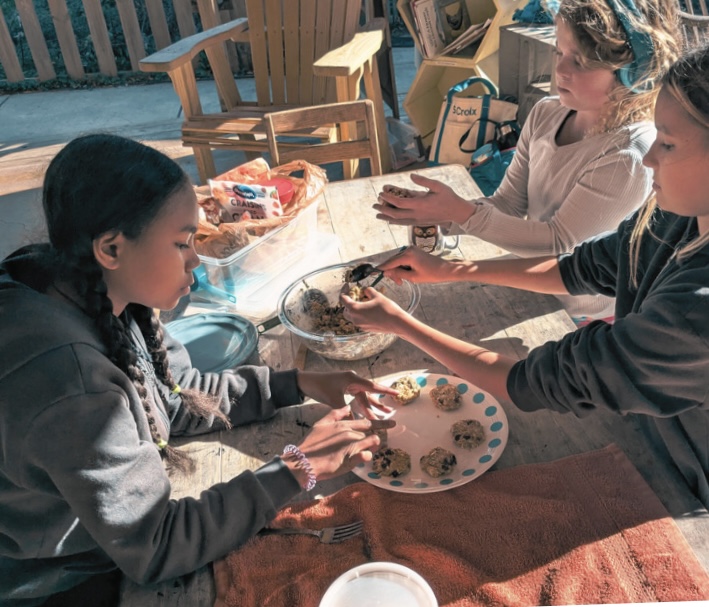
Jennie Jones runs The Treehouse. She has a student in his second year with her who has historically resisted anything involving a writing utensil. One day, the kids were doing soda experiments and he started writing a recipe card, sounding out the first letter of each ingredient.
"I quickly caught a photo of his recipe card," Jennie wrote, "but the part of the story I got to share later in Prism was the fun conversation he and I had. I shared how awesome it was to see him writing and asked if it had gotten easier for him. He said, no, it's still hard. I'm just trying my best. I loved hearing that growth and shared it on Prism, because you wouldn't know that from his faint letters on his card."
That's the practice. It's not just record-keeping. It's a discipline that develops the educator who engages in it. The more you observe, the more angles you develop, and the richer your understanding of each child becomes. Your first portfolio entries might be surface-level, and that's fine. Over time, your eye changes.
It changes what parents see, too. Jennie told me about a mom who brought her oldest son in for a trial day after enrolling his two younger siblings: "She specifically said, I see all the cool things you guys are doing on Prism and I just think he would love it here."
When parents can see the texture of what's actually happening in a microschool, not just the highlight reel, trust builds differently. Enrollment conversations get easier. Reporting for ESA programs and homeschool compliance becomes a byproduct of normal practice rather than an end-of-year scramble.
This isn't just a tooling problem for individual schools. It's a movement-level challenge.
Microschools are proliferating because they do something conventional schools can't: they organize around the gifts of the educators who run them and the needs of the learners who enroll in them. They specialize. They support the development of the whole child, not just the academic slice. That's the source of their value, and it's also the reason existing tools don't fit. There hasn't been an established way to capture and communicate what these spaces actually cultivate.
But as school choice programs expand and microschools become more visible and more publicly funded, the accountability conversation is coming. It's already here, actually. And if we don't articulate what evidence of learning looks like on our own terms, someone else will define it for us. The risk is that standardized tests, grade-level benchmarks, and curriculum checklists will get imposed on the very spaces that were created to escape them.
The microschool movement doesn't need to prove itself on the old terms. It needs to define better ones. That means building tools and practices that communicate the real depth and breadth of learning in environments where relationships, agility, and collaboration matter more than command and control. It means sharing the value of what we're doing in ways that are credible and legible to the outside world, without flattening the experience into a single score.
That's why I built Prism. Not just to solve the daily friction, though it does that. To give this movement a way of seeing itself, and a way of being seen.
Tomis Parker is the founder of Prism (prism.guide), co-founder of the Agile Learning Centers network, and co-founder of the Alliance for Self-Directed Education. He has led operations at ALC Mosaic in Charlotte, NC since 2014.
Ashley Soifer : Aug 2, 2025, 4:38:48 PM

 News Story Posted by Center Staff : Jan 7, 2026, 11:42:40 PM
Download this new White Paper here.