4 min read

Rubric Reboot 2026: What Happens When Learners Set the Standards

Rubric Reboot 2026: What Happens When Learners Set the Standards

This article was originally published on Teaching on the Hedge.

Before launching the Hedge School back in January 2021, we had discussed in our PSTS [Parent, Student, Teacher, Supporter] meetings that we wanted to authentically embody what it meant for the students to be in charge of their learning. We did not want to merely pay lip service to the idea.

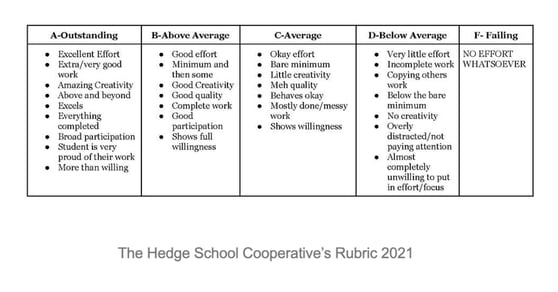
Within that first semester, we decided what our colors were going to be, what our mascot was going to be, and then we tackled something a little more essential: how we were going to measure our growth as learners, as a school, and as educators? We scrapped the idea of downloading a rubric from another source and following it. Instead, the students created the rubric with me. I started us off with a framework that stated: here is top-of-the-line performance, and here is bottom-of-the-line performance. The only category I filled out was the “F” rating. And this basically said the learner didn’t show up to school, didn’t do any work, and never spoke a word. They would really have to work at failing because all participation, on some level, is participation. If you’re participating, if you’re listening, and if you’re showing up, all of these things are worthy of acknowledgment.

From there, it went from below average to above average to outstanding, and the students decided for each of the categories what the designations would look like, and this produced what I thought was a great rubric. As we were all coming from the public school sphere, though, it turned out a little more traditional than we realized at the time. See our first effort below.

Hedge School Rubric 2021

From that rubric, we moved forward and created a self-evaluation form where the students had to look at where they were and how they would rate themselves in that category. Were they pushing themselves enough? Did they feel like they had the material they needed? Were they given enough time and opportunity? Were they taking enough time and opportunity, and so on? And this worked for us for about five years.

However, as we grew as a school, I knew that we were actually doing things a little more nuanced than the rubric gave us credit for. As is so often the case at the Hedge, I brought this observation to the students: Does our rubric still serve us? Almost immediately, one of my seniors stood and said, “you know, Doc Flynn, I think that rubric ‘works,’ but it just doesn’t reflect us, and the self-evaluation form is a little confusing; it doesn’t really ask questions that mean a whole lot to me.” When they are free to speak their minds, students are keenly able to spot the nature of a problem.

I told them that after lunch I would be in the front room. The big white board would be out, and I would have all of the stuff that we currently had, and anybody who wanted to join me in reevaluating and reframing our rubric and self-evaluation should feel free to join me. All of them did. The very first thing they pointed out was something I’d never thought about.

“We have to get rid of this word ‘average,’ which has never sat well with me when going through the self-eval process – what does that even mean?”

I agreed, thinking — not for the first time — “so there is some more unschooling for you, Flynn.” It is a hard habit to break. In fairness, “average” doesn’t really offer much meaning anymore, especially when we are referring to human beings and their ability to learn. A discussion for another day.

We all sat down and started going through the rubric and the evaluation questions line by line. We removed questions that we felt had no real meaning to us and started asking questions that we felt had more relevance. Again, my role was to move us through, without commenting as much as possible. Our older students led the way in dissection and alteration. They had been here a while and had already figured out what worked for them and what did not.

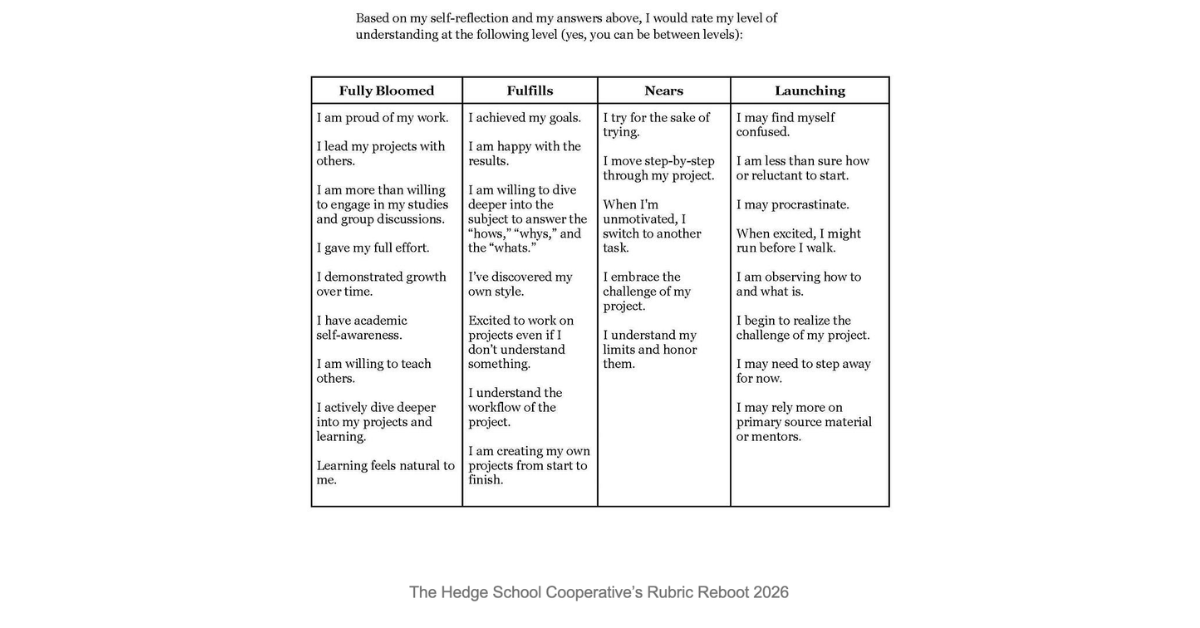
When we got to the rubric, we completely scrapped “does not meet,” “below average,” “above average,” and “outstanding.” Starting from scratch, I asked each of them to write down what terminology they would use to rank performance and understanding. We then put all of the terminology up on the board and voted on which one they thought would work for each designation. We ended up with a mix of terms, so rather than it being all nautical in nature, all gardening in nature, all academic in nature, it became a lovely little hodgepodge, which, in fairness, does seem to be who we are.

Here we were, staring at the new designations: “Launching,” “Nears,” “Fulfills,” and “Fully Bloomed.” Now we had to define what each of these stages looked like for a learner. The most impactful moment for me happened at this point when they gave the following suggestion: “I think we should pose these statements and questions from the ‘I.’ Everything right now states ‘you do this, you do that,’ and I feel like if it says ‘I achieved this or I felt proud,’ that really does help me decipher if those statements actually relate to me as a human being.” Here we were again, switching from a demand, or a command, “you,” to empowerment, “I.” It was such a beautiful moment in the process that I don’t even really know how to explain it – there is something transformative about allowing people, regardless of their age, to speak their honest truth into this world. The entire language started to change all around. We moved from “the student/you will demonstrate” to “I would feel really comfortable teaching this to my fellow students,” or “I am just at the beginning of this and I do not even know where to start.”

Hedge School Rubric 2026

Now I’m not going to say I didn’t have any influence in this at all, because I did. I was a part of the conversation as well, but I do feel confident that the learners led the changes and languaging. After we had finished, I asked my students who were willing to write a reflection on how this entire process felt for them, and with permission I am sharing one of the students’ responses. They are a very thoughtful human being who did graduate in May and have been an honor to teach. Thank you, Hugh.

The self-assessment at Hedge always felt like it didn’t really fit with the rest of the school here, so I’m glad I was able to be a part of the redesigning process. We worked through every part of it, changing what didn’t seem right; it took two days. Overall, we tried to remove the aspect of comparing yourself to others because that is a very dangerous mindset. Just the language used in the original was problematic for us because it was made by students who just came out of traditional schooling. Meaning there was this sense of external pressure put on you, almost like it wasn’t an actual self-assessment. One thing I really enjoyed was how we used ranked-choice voting to name each category. The word “average” in the old self-assessment was problematic and made me realize how different traditional schooling is from the experience here at Hedge. We even removed grades entirely from the self-assessment, as well as removing the failing category, because it’s not possible to “fail” here. I could definitely feel the other students getting tired of working on it after a while, but I think the students should redesign the self-assessment every four to five years as the students and school change.


The Beauty And Difficulty Of Living Out Your Ethos

The Beauty And Difficulty Of Living Out Your Ethos

Last week, one of my students told me that he had made the difficult decision to attend another school. Not because he didn’t love his time at Hedge;...
Read More
When Children Want to Be at School: What Microschool Parents Are Telling Us

When Children Want to Be at School: What Microschool Parents Are Telling Us

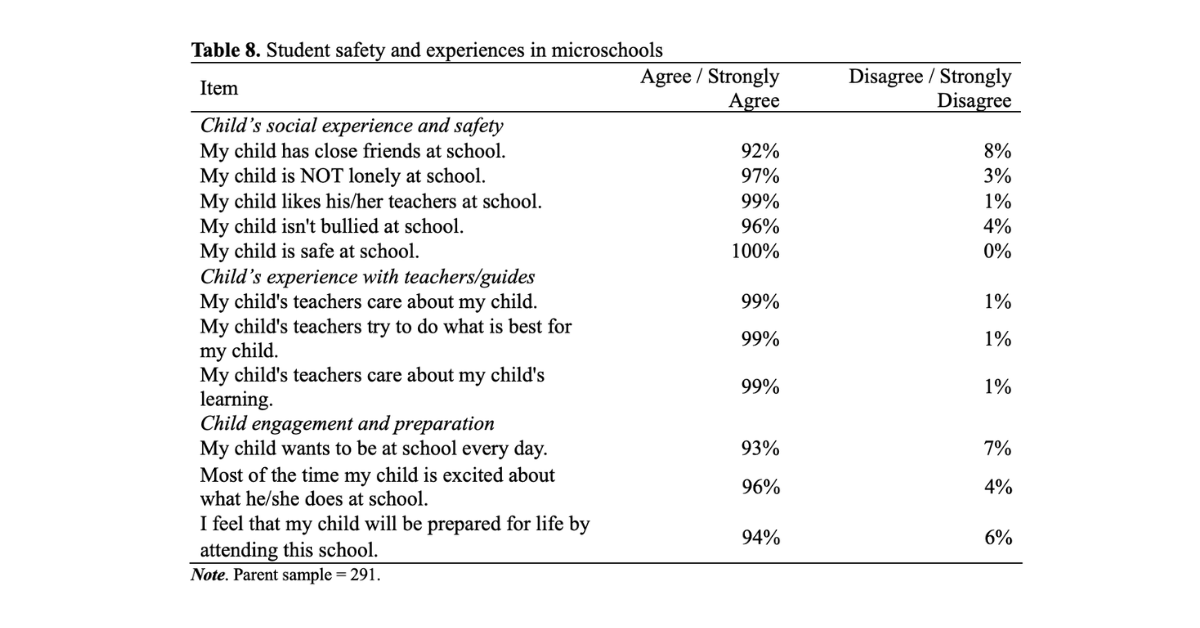
What does it mean for a family when their children actually want to go to school? In the latest National Microschooling Center research publication,

Read More