An Early Look At Microschooling In America (From Forbes)
This article appeared in Forbes, where it can be found in its entirety.
1 min read
Don Soifer and Ashley Soifer : Jun 11, 2026 10:49:12 AM
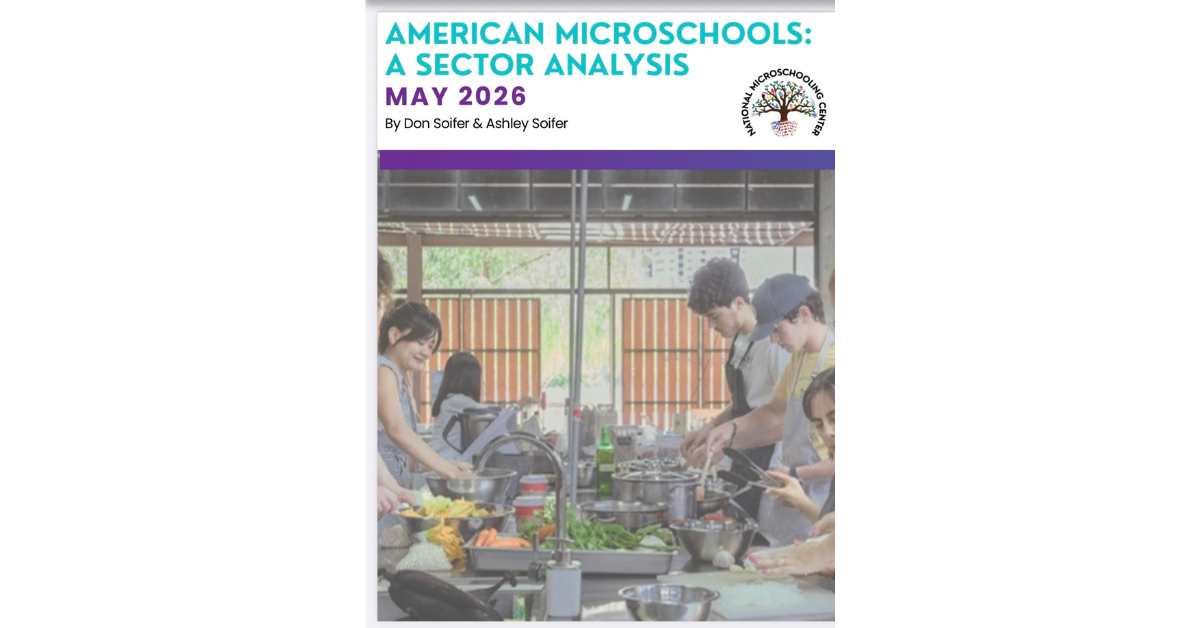
The National Microschooling Center just published its latest report, the American Microschools 2026 Sector Analysis, it's most ambitious yet.
This report comprises the most thorough research published to date on microschools in America, examining 1,000 microschools located in all 50 states, the District of Columbia and Puerto Rico. Most are currently operating, with prelaunch microschools as well as those which have closed their doors also included.
The highly diverse education models found across today’s microschooling sector operate with a dynamism and responsiveness far less common across other education sectors in the United States. This analysis seeks to offer insights into how they create their microschools and conduct their work, and which trends characterize the movement and the landscapes within which they serve students and families. America's microschooling founders as a group are getting a lot less white, as this report explains one important example.
Microschools, able to provide new, popular schooling options in communities leveraging flexibilities in education requirements, often face barriers not only from education frameworks but noneducation frameworks as well. Accordingly, they dedicate nearly 100 hours each year on average completing compliance-related tasks, posing barriers to sector growth.
This 2026 edition of the annual American Microschools Sector Analysis series by the National Microschooling Center includes questions on a number of new topics, including ways microschools are impacted by different regulatory and policy stipulations, specifics of educational, business and operational aspects within the microschooling sector. Other questions revisit topics examined in previous studies, to illuminate trends over time and effects of growth and evolution on the ways microschools operate.
Other findings include:
• One in five current microschools examined have been open for six years or longer, 45 percent have been open for three to five years, 17 percent for one to two years, and 16 percent for less than one year.
• A trend among highly diversified models of microschools, especially prelaunch microschool founders, identifies growth in nonacademic learning as their most desired student outcome for the students they serve for the first time our research has tracked this.
• The research finds half of microschools indicated their families receive funding from state-provided school choice programs, while three in five rely primarily on tuition-based funding from families. Most microschools (66 percent) offer sliding scale tuition discounts.
This article appeared in Forbes, where it can be found in its entirety.
What are the main motivators of prospective microschool founders? While many choose to describe this group of ambitious educators as entrepreneurs,...
Read More